How hula hoop practice at home grew into VoiceControl Stopwatch — a voice-controlled stopwatch with spoken time announcements.
Contents
One winter, a simple thought occurred to me: my daughter wasn’t moving enough.
Summer is easier. Walks, playgrounds, a bike, roller skates, a jump rope, the yard. In winter there’s usually less of all that: more time indoors, more sitting, less spontaneous movement.
I wanted to add something active to her day, but without pressure. Not as a “you have to exercise,” but more like a game: try it, get interested, see the progress, and feel that it’s working.
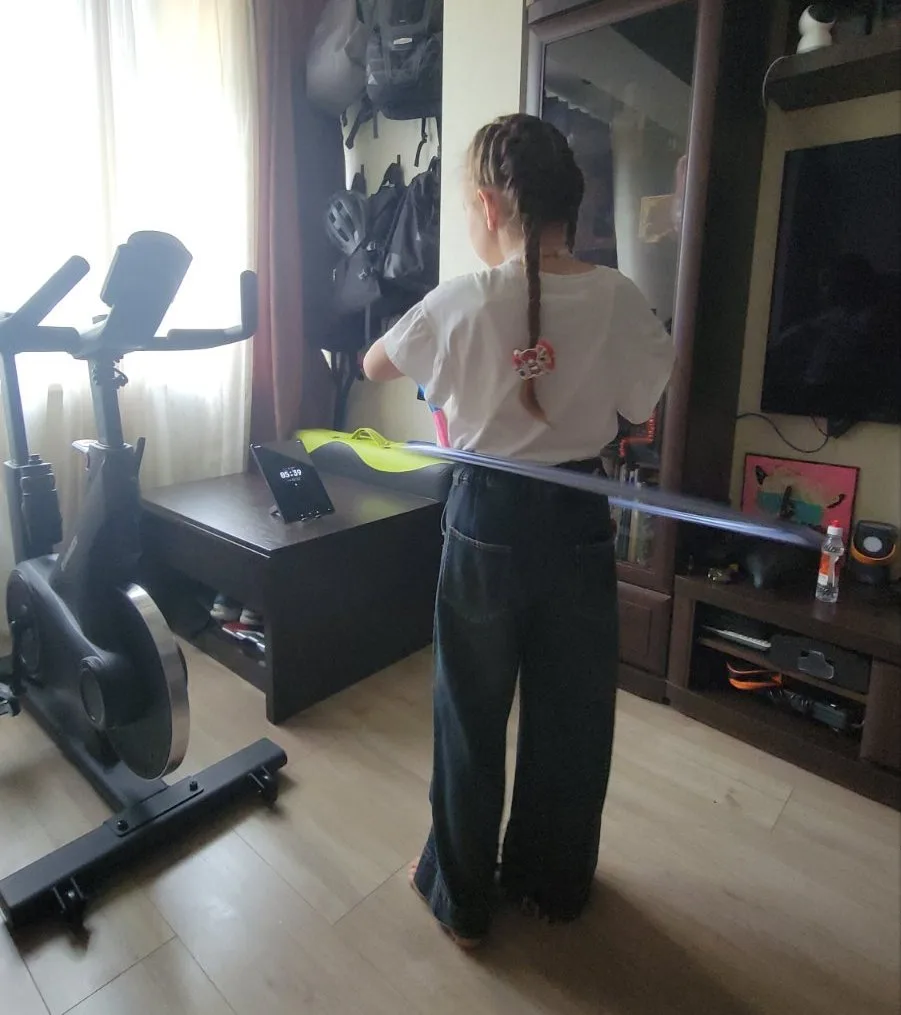
I suggested that she try spinning a hula hoop. She was seven at the time.
At first it seemed to her that it would be easy, simple and fun. It looked like all she had to do was pick up the hoop, start spinning — and it would just work. But it quickly turned out that it wasn’t so simple after all.
Sometimes the hoop fell almost immediately. Sometimes she managed less than a minute. She’d get upset, then try again. And I sat next to her, timing it, cheering her on, and being glad about every small bit of progress.
I’ve always liked watching how the movements of people who play sports gradually change. At first they’re a little clumsy, uncertain, with extra effort. And then at some point they become more precise, calmer, more economical.
I’d noticed before that in some sports progress often comes in jumps. A child tries for a long time, makes mistakes, repeats — and suddenly the movement starts to come out in a completely different way.
That’s how it was, for example, when my daughter was learning to roller-skate at four. At first everything was hard, but at some point her movements suddenly changed: she started skating more confidently, more freely, almost like an athlete.
With the hoop, I saw a similar moment again. And I was really happy.
Because after that she genuinely started to enjoy spinning the hoop. It was no longer “dad suggested it” or “I should give it a try.” She could see for herself that it was working better and better. She wanted to keep going, to beat her record, to last a little longer.
I generally try to support her different activities, especially the sporty ones. And every time it’s a real joy: when a child first hesitates, then tries, then starts to succeed — and at some point begins to enjoy it on their own.
Probably it’s for moments like these that parents come up with little games, motivation systems, records on a board, and everything else.
A little motivation system
To make it more interesting for her, I came up with a simple system.
If she spins the hoop for a total of 10 minutes a day — even with breaks, drops, and fresh tries — she gets 10 extra minutes of cartoons. And if she manages to spin for 15 minutes or more without stopping, the bonus goes up to 15 minutes.
Of course, I don’t think motivation should be built on rewards alone. But sometimes a small, clear bonus helps a child take the first steps — especially when an activity hasn’t become a habit yet.
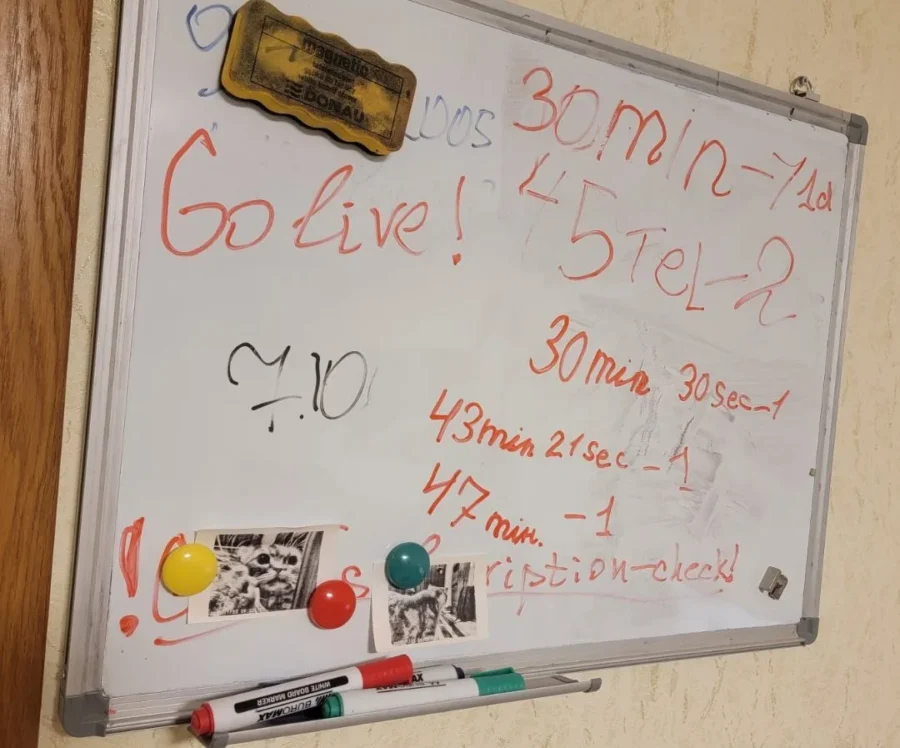
We wrote her personal records on a whiteboard. Sometimes the numbers were in no particular order, with magnets and black-and-white photos of our cat next to them. But for her it was a real table of achievements.
She could see her progress. She saw that yesterday it was 3 minutes, then 5, then 8, then more. And she wanted to try again.
So the hoop gradually became part of her day. Not something mandatory and boring, but a small habit with a bit of play, a goal, and a clear result.
Movement, habit, and a few family experiments
Later we started trying other activities too.
In summer there was a jump rope. The season ended sooner than we’d have liked, but the progress was already noticeable.
Right now we’re trying the banya (a traditional steam bath) and cold water — carefully and in a playful way.
And here I saw again that, when it comes to building habits, one single thing rarely works. Usually it all comes together: interest, the example of adults, mood, play, small goals, support, and the people around.
For instance, I started gathering other kids and parents so that going to the banya would be more interesting for my daughter. The first time, she and the other kids were unhappy for about half of it. It felt unfamiliar: too hot, too cold, and not clear why it was even needed.
But closer to the end, something changed. They started laughing, comparing what they’d tried, and in the end decided themselves that they wanted to come again.
The hardest part is getting into cold water. And not after the steam room, once she’s already warmed up — she got used to that too, and it came more easily. The toughest moment is at the very start, before the banya, when the body isn’t warmed up yet. Especially in winter, when the water is icy and it’s cold all around.
And that’s where my support helps: to encourage her, to turn it into a small challenge, to mark every attempt, to show her that she did it.
Not to force. Not to push. Just to be there at the moment when a child is a little short on confidence.
For us this is very much a family experience — no pressure, guided by how she feels, and always with adult supervision.
That’s how, little by little, not only a habit appears, but also a feeling: “I can do it.”
But I wasn’t always there
When I sat next to her, everything worked well. I started the stopwatch, stopped it, told her how much time had passed, cheered her on, helped write down the records.
But one day I realized a simple thing: when I’m not nearby, it’s much harder for her to practice on her own.
She has to stop, walk over to the phone or tablet, look at the screen, press a button, and then start again. With a hoop, a jump rope, or another exercise that’s inconvenient — the movement breaks, and so does the mood.
And in some situations you just don’t want to touch the screen at all. For example, when your hands are wet after a shower, the pool, or the banya.
I started looking for a simple voice-controlled stopwatch with spoken time announcements. I wanted to be able to say a command without walking over to the phone. For the app to announce the time itself.
I couldn’t find a suitable option for myself. So I decided to make my own app.
That’s how VoiceControl Stopwatch appeared — a voice-controlled stopwatch you can use without touching the screen.
A voice-controlled stopwatch that doesn’t get in the way
The idea of the app is very simple: a stopwatch should help, not distract.
When a child spins a hoop, jumps rope, or does an exercise, she doesn’t need to walk over to the screen each time. She can just say a voice command and keep going.
The app can announce the time out loud, so you don’t have to keep looking at the screen. That’s handy when it matters not to break your rhythm and to stay in motion.
It can also be used even with the screen off (with certain settings). That’s handy in the banya, for example: you can time something without touching the phone with wet hands.
Over time the app became more than the first simple version for the hoop. It now supports 16 languages and profiles: you can set up different scenarios — for a hoop, a jump rope, workouts, intervals, stretching, an exercise bike, or other repeating activities.
But for me its main point has stayed the same. It’s a small tool that helps a person practice a little more independently.
Who the app might be useful for
I made VoiceControl Stopwatch first of all for my own family. But over time I realized the idea could be useful to others too:
- parents who want to gently motivate a child to move more;
- people who train at home and don’t want to look at the screen every time;
- those who need to hear the time right during an exercise;
- those whose hands are busy or wet;
- those who use different practice scenarios and want to switch between them quickly.
Of course, the app on its own doesn’t create a habit. Especially for a child. That still takes attention, play, support, a personal example, small wins, and the feeling that it’s working.
But a good tool can remove an extra obstacle. In our case, that obstacle was an ordinary stopwatch you have to keep walking up to and pressing buttons on.
Why I keep developing the app
For me, VoiceControl Stopwatch didn’t start as a big project or a business idea. It started with an ordinary family situation.
A child learns a new movement. At first it doesn’t work. Then it works a bit better. Then comes the first record. Then another. And then you see that she’s already interested in keeping going on her own. And that’s a very warm moment.
I wanted to make a simple tool that supports movement, independence, and small daily wins.
At first it was a stopwatch for my daughter and her hoop. Then it turned out that similar situations happen to many people: parents, kids, people who train at home, do sports, are rebuilding the habit of moving, or just want to make their practice more convenient.
If this app helps someone else too — then I didn’t make it in vain.
What matters here
Can the app replace an adult’s attention?
No. Especially with young children, that is important to say plainly.
For a child, an adult’s attention is often more important than the exercise itself. It matters that mom or dad is nearby, watching, noticing the attempts, enjoying small progress, and turning the activity into a game. When dad personally times the attempt, praises a new record, and helps write the result on the board, it is not just tracking time. It is part of being together.
VoiceControl Stopwatch does not replace that attention. It helps preserve what has already started to work: when the child wants to try again on her own, when parents are busy, when walking over to the phone after every attempt gets in the way, or when it is simply useful to give the child a little more independence.
Why did voice control become so important?
When a child is still learning a new movement, there can be many attempts. The hoop may spin for just a few seconds and fall. Then again. And again. Each time the child has to gather herself, start the movement, and find the rhythm.
If she also has to walk over to the phone, press start, reset, pause, or look at the screen, attention gets scattered quickly. It is already hard for children to stay focused for long, and a regular stopwatch adds one more small obstacle.
Voice control removes part of that extra fuss. You can say a command and keep trying. You can hear the time without stopping the movement. It does not make the exercise easy, but it makes the process calmer and more convenient.
Why write down small records at all?
Because children need to see that they are getting somewhere. Not just “good job”, but something concrete: yesterday it was a few seconds, today it was more. That kind of progress is easy to understand and easy to feel.
In our case, a simple board with records worked better than any complex system. It turned attempts into a small game: try again, beat your own result, see a new number. The app grew out of the same idea — make time and progress easier to notice, without turning the activity into pressure.
VoiceControl Stopwatch is a voice-controlled stopwatch with spoken time announcements, profiles, and support for 16 languages. It helps you practice without being distracted by the screen.
